Key Takeaways
- Use phone number as primary identity key across all channels
- Standardize messages into a common envelope format for routing consistency
- Treat voice as a first-class channel with transcripts and structured data capture
- Build consent tracking into your identity model from day one
- Design handoffs as products with summaries, criteria, and suggested next steps
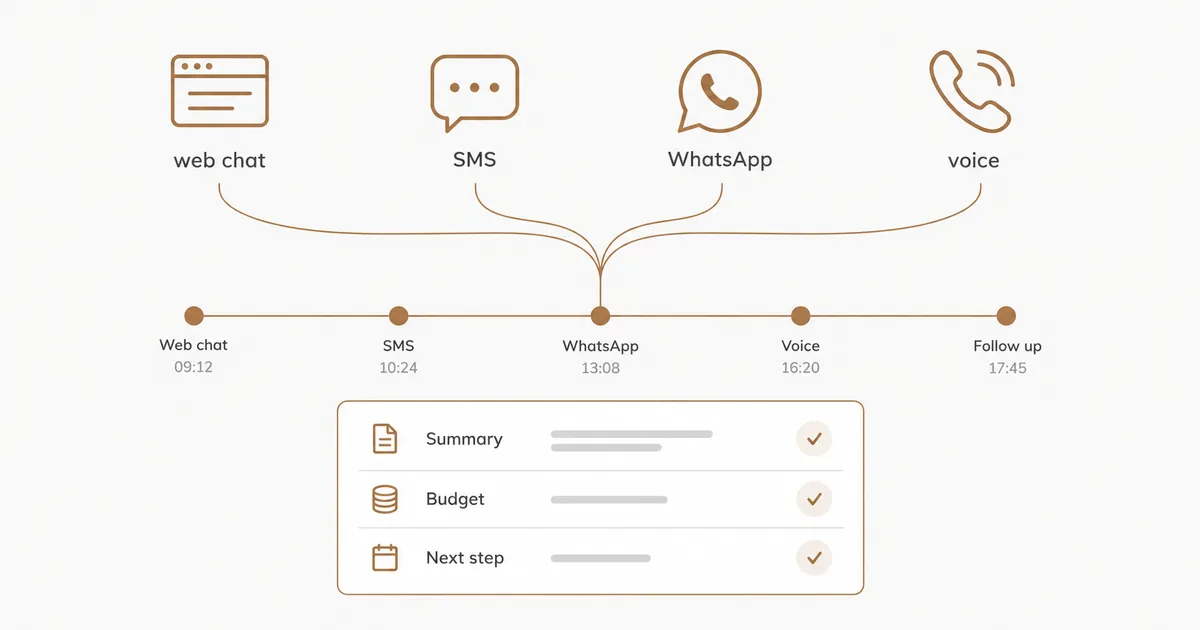
"We're available 24/7" is easy to say. It's harder to execute across channels without creating chaos: duplicate leads, broken context, and agents asking the same questions again. In real estate, where timing is everything and a delayed response can mean losing a qualified buyer to a competitor, the stakes are particularly high.
The problem isn't just availability—it's continuity. A prospect might start a conversation on your website at 2 PM, send a WhatsApp message at 8 PM, and call your office at 9 AM the next day. Without proper systems, each touchpoint feels like starting from scratch. The frustration builds, trust erodes, and conversion rates plummet.
True omnichannel coverage is a systems problem, not a staffing problem. The goal is deceptively simple: one conversation thread, even when the customer switches from web chat to SMS to WhatsApp to a phone call. When implemented correctly, your team sees a complete history regardless of channel, and customers never have to repeat themselves.
This article walks through the six fundamental building blocks of effective 24/7 omnichannel coverage, with practical implementation guidance drawn from real-world real estate deployments.
1) Choose a single source of truth for identity
If you can't reliably answer "who is this?", everything else degrades. Identity resolution is the cornerstone of omnichannel lead management. Without it, you'll create duplicate records, lose conversation context, and deliver a fragmented experience that frustrates prospects and wastes your team's time.
The challenge is that different channels provide different identifiers. Web chat might start anonymous with just a session ID. SMS and WhatsApp are tied to phone numbers. Forms capture email addresses. Voice calls provide caller ID. Your system needs a strategy to unify these disparate signals into a single customer profile.
Recommended identity hierarchy:
- Phone number as primary key — This is the most reliable identifier across SMS, WhatsApp, and voice channels. It's also increasingly used for web authentication. In real estate, phone numbers tend to be more stable than email addresses and provide direct access for time-sensitive communication.
- Email as secondary identifier — Essential for form submissions, CRM integration, and document delivery. Many prospects provide email before phone, especially on initial web inquiries. Email also serves as a fallback when phone numbers change.
- Device/session IDs for anonymous tracking — When a prospect first lands on your website, you don't yet have PII. Track their behavior with session cookies or device fingerprints, then promote to a full identity record once they provide contact information. This preserves valuable behavioral context.
- CRM external IDs — If you're integrating with Salesforce, Follow Up Boss, LionDesk, or another CRM, maintain bidirectional linking. Store the CRM's ID in your system and vice versa to prevent duplicate creation and enable two-way sync.
Common mistakes to avoid:
- Creating duplicates on phone format variations — "+1 (555) 123-4567" vs "5551234567" vs "+15551234567" should all resolve to the same contact. Normalize phone numbers to E.164 format before storage and lookup.
- Not handling multiple people sharing a device — In household contexts (especially luxury real estate with couples), multiple people might use the same computer. Rely on explicit authentication (phone/email capture) rather than assuming device = person.
- Failing to merge when both phone and email exist — A prospect might submit a web form with their email, then later send a WhatsApp message. You need logic to detect when email record A and phone record B belong to the same person, then merge them intelligently.
Implementation approach:
Build a unified contact table with these fields: id (UUID), phone (E.164), email, first_name, last_name, language, created_at, updated_at, merged_into (for handling duplicates), and crm_id. When a message arrives on any channel, your ingestion flow should:
- Extract available identifiers (phone, email, session ID)
- Normalize phone numbers to E.164 format
- Query existing contacts by phone (primary) or email (secondary)
- If found, use existing contact ID; if not, create new contact
- If both phone and email are provided and match different contacts, trigger merge workflow
- Update contact metadata (last seen, channel preference, language if detected)
Pro tip: Once identity is stable, you can keep history, preferences, language, timezone, consent status, and custom attributes attached to the right person across all channels. This is the foundation everything else builds on. Without solid identity resolution, you're building on sand.
2) Standardize a conversation envelope
Different channels speak different languages. Web chat sends JSON objects. SMS delivers plain text with limited metadata. WhatsApp includes media attachments and structured buttons. Voice calls produce audio streams and transcripts. Without standardization, your routing logic becomes a maze of channel-specific conditionals that's impossible to maintain.
The solution is to create a unified message envelope—a standardized data structure that wraps all inbound and outbound messages regardless of source. Think of it as a translation layer that converts channel-specific payloads into a common format your business logic can process uniformly.
Core message envelope fields:
- Channel — Enum value:
web_chat,sms,whatsapp,voice,email,instagram_dm, etc. This tells your system how to route replies and where to display the message in agent interfaces. - Direction —
inboundoroutbound. Critical for conversation threading and compliance (especially for SMS/WhatsApp where regulations differ based on who initiated). - From / To identifiers — Normalized phone numbers or email addresses. For anonymous web chat,
frommight be a session ID until the prospect identifies themselves. - Timestamp — ISO 8601 format with timezone. Essential for SLA tracking, conversation ordering, and quiet hours enforcement.
- Content — The actual message body. For text, store as UTF-8 string. For voice, store transcript text separately from audio recording URL.
- Attachments — Array of media objects with
type(image/video/audio/document),url,size, andmime_type. WhatsApp and web chat commonly include images; voice includes call recordings. - Conversation ID — UUID linking all messages in a thread. This is your primary mechanism for maintaining context across channels. When a prospect switches from web to WhatsApp, messages should append to the same conversation.
- Contact ID — Foreign key to your unified identity table. Links every message to the resolved person.
- Metadata — Flexible JSON field for channel-specific or campaign-specific data:
utm_source,property_id,listing_url,campaign_name,language_detected,sentiment_score,intent_classification, etc.
Why this matters:
With a standardized envelope, your routing engine, analytics pipeline, CRM sync, and agent dashboard all consume the same data structure. You write business logic once instead of maintaining separate code paths for each channel. When you add a new channel (say, Instagram DM or Telegram), you just write a new adapter that converts to your standard envelope format.
Real-world example schema:
{
  "id": "msg_9k3j2h1g",
  "conversation_id": "conv_5a7b2c9d",
  "contact_id": "contact_8f4e3a1b",
  "channel": "whatsapp",
  "direction": "inbound",
  "from": "+15551234567",
  "to": "+15559876543",
  "timestamp": "2025-01-15T14:32:18Z",
  "content": "Do you have any 3BR condos in Wynwood under $800k?",
  "attachments": [],
  "metadata": {
    "property_id": null,
    "campaign_source": "google_ads_miami_condos",
    "language": "en",
    "intent": "property_search",
    "urgency": "medium"
  },
  "status": "delivered"
}
Implementation tips:
- Build channel adapters as separate modules — Each adapter (Twilio for SMS, WhatsApp Business API, Vocode for voice, custom websocket for web chat) should have one job: translate between channel-specific format and your envelope.
- Use message queues for reliability — Inbound messages should hit a queue (Redis, RabbitMQ, AWS SQS) before processing. This prevents data loss during deployment or server restarts and allows you to scale processing independently.
- Store raw payloads alongside envelopes — Keep the original channel payload in an
raw_payloadfield for debugging and compliance. Sometimes you need to reference the exact data the provider sent. - Version your envelope schema — Add a
schema_versionfield. As your business evolves, you'll want to add fields without breaking existing consumers.
This standardization is what makes routing, analytics, reporting, and handoffs consistent across all channels. It's the difference between a fragile, channel-specific system and a scalable, maintainable omnichannel platform.
3) Treat voice as a first-class channel
Voice is where urgency shows up—and where most omnichannel systems break. Too often, voice is treated as a separate silo: calls go to one platform, text conversations to another, and the two never meet. This creates exactly the fragmentation you're trying to avoid.
In real estate, voice is particularly critical. When someone calls about a property, it's usually because they're ready to move forward. They've already browsed online, read listings, maybe even driven by the neighborhood. The call is a high-intent signal. If your voice channel doesn't integrate with the rest of your lead flow, you're leaving money on the table.
The challenge with voice integration:
Unlike text-based channels where the entire conversation history is already digital, voice produces audio. To make it a first-class citizen in your omnichannel system, you need to:
- Transcribe in real-time — Use speech-to-text (Deepgram, AssemblyAI, Google Speech-to-Text) to convert audio into text. This enables searchability, sentiment analysis, and context preservation.
- Store transcripts with word-level timestamps — Don't just save the full text. Store timestamps for each word or phrase. This allows you to link specific statements to specific moments in the audio recording, which is invaluable for training, compliance, and dispute resolution.
- Capture structured data during the call — The transcript is valuable, but even better is extracting structured fields in real-time: budget range, preferred neighborhoods, move-in timeline, financing status, number of bedrooms, etc. Use LLM-based extraction or rule-based parsing to populate these fields as the conversation progresses.
- Summarize the call into a CRM note — Generate a concise summary (2-4 sentences) that captures the key points: "Buyer looking for 3BR condo in Brickell, budget $600-700k, pre-approved with Wells Fargo, wants to move by March. Interested in new construction with amenities. High intent."
- Trigger next actions automatically — Based on what was discussed, queue follow-up tasks: send matching listings, schedule a tour, assign to a specific agent, send pre-approval info, etc. The call shouldn't end in a vacuum.
Real-world scenario:
A prospect named Sarah has been chatting with your AI on the website for 3 days. She's asked about waterfront properties, expressed interest in 2BR units under $500k, and clicked through several listings. Then she calls.
Without voice integration: Your voice AI or receptionist answers, has no context about Sarah's previous conversations, asks the same qualification questions again ("What are you looking for? What's your budget?"), and Sarah gets frustrated.
With voice integration: Your system recognizes Sarah's phone number, pulls up her conversation history, and the voice agent says, "Hi Sarah, I see you've been looking at 2-bedroom waterfront units in the $400-500k range. I have a few new listings that just came on the market that I think you'll love. Would you like me to send those over, or would you prefer to schedule a tour?"
Technical implementation:
- Use voice-native platforms with API access — Tools like Bland AI, Vapi, Vocode, or Retell AI provide real-time transcription, conversation state management, and webhook integrations. They handle the telephony complexity so you can focus on business logic.
- Store call recordings and transcripts as message objects — Treat the call as a message in your unified envelope. The
contentfield contains the transcript,attachmentsincludes the audio recording URL, andmetadataincludes structured fields extracted during the call. - Enable "resume conversation" across channels — If a call drops or the prospect says "I need to think about it and will text you later," your system should remember the conversation state. When they send a WhatsApp message 3 hours later, continue from where you left off.
Common mistakes:
- Only storing the audio file — Audio is hard to search, analyze, or reference quickly. Always generate and store a transcript.
- Not extracting structured data — A 10-minute call contains valuable qualification data. If all you save is a transcript, your agents have to re-read it to find the key details. Extract budget, timeline, preferences, objections, etc. into fields.
- Ignoring call sentiment and intent — Use sentiment analysis to flag frustrated or delighted callers. Use intent classification to prioritize hot leads vs. informational inquiries.
The best voice experience is not "AI replaces humans." It's "AI handles intake flawlessly, captures perfect context, and hands off to humans with everything they need to close the deal."
When voice is treated as a first-class channel—with transcripts, structured data, summaries, and seamless handoffs—it becomes your highest-converting channel instead of your biggest leak.
4) Make consent and compliance part of the flow
Messaging channels come with strict regulations. In the United States, the Telephone Consumer Protection Act (TCPA) requires explicit written consent before sending marketing messages via SMS. WhatsApp has similar requirements. Violate these rules and you risk fines up to $1,500 per message, lawsuits, and carrier blocking.
Compliance isn't just about avoiding legal trouble—it's about respecting your customers and maintaining deliverability. Carriers and platforms actively monitor for spam behavior. If your messaging patterns look suspicious (high opt-out rates, spam complaints, messages sent during quiet hours), they'll throttle or block you entirely.
Build consent tracking into your identity model from day one:
- Explicit opt-in for SMS/WhatsApp where required — Don't rely on "soft consent" (like form submissions without a checkbox). Store when, where, and how consent was obtained: web form, verbal during a call, check-in at an open house, etc. Include the exact timestamp and IP address for audit trails.
- Granular consent by channel and purpose — A prospect might consent to receive listing updates via WhatsApp but not promotional messages via SMS. Store consent as a matrix:
sms_transactional,sms_marketing,whatsapp_transactional,whatsapp_marketing,voice_calls, etc. - Handle STOP/unsubscribe gracefully — When someone replies "STOP" to an SMS or uses WhatsApp's report/block feature, immediately flag their contact record and suppress future messages. Include this in your message routing logic—before sending, check consent status.
- Respect quiet hours — Don't send marketing messages before 8 AM or after 9 PM in the recipient's local timezone. Transactional messages (appointment confirmations, password resets) can be exempt, but marketing messages sent at 11 PM will generate complaints and hurt deliverability.
- Implement escalation safeguards — If an AI conversation goes poorly or a prospect requests a human, your system should detect this and route accordingly. Don't let automation keep pushing when someone has explicitly asked to speak to a person.
- Maintain detailed audit logs — For compliance and dispute resolution, log every consent grant, every message sent, every opt-out, and every complaint. Include timestamps, IP addresses, channel, message content, and delivery status. This protects you legally and operationally.
Consent capture best practices:
- Use clear, unambiguous language — "By submitting this form, you agree to receive text messages and calls from [Company] at the number provided. Message frequency varies. Reply STOP to opt out." Avoid buried legalese.
- Make consent action-based, not passive — Require a checkbox or button click specifically for SMS/WhatsApp consent. Pre-checked boxes don't count as explicit consent under TCPA.
- Double opt-in for high-risk campaigns — For cold lists or purchased leads, send a confirmation message: "Reply YES to confirm you want to receive updates from [Company]." Only proceed if they confirm.
- Re-confirm consent periodically — If a contact hasn't engaged in 12+ months, consider sending a re-engagement campaign asking them to confirm they still want to hear from you.
Technical implementation:
Add these fields to your contact table:
{
  "consent": {
    "sms_marketing": {
      "granted": true,
      "timestamp": "2025-01-10T14:23:11Z",
      "source": "web_form_contact_page",
      "ip_address": "192.168.1.100"
    },
    "whatsapp_transactional": {
      "granted": true,
      "timestamp": "2025-01-12T09:15:42Z",
      "source": "inbound_whatsapp_message"
    },
    "voice_calls": {
      "granted": false
    }
  },
  "timezone": "America/New_York",
  "quiet_hours": {
    "start": "21:00",
    "end": "08:00"
  }
}
Before sending any message, run a consent check:
// Pseudo-code
if (!contact.consent[channel][messageType].granted) {
  log("Message blocked: no consent");
  return;
}

if (isQuietHours(contact.timezone, contact.quietHours)) {
  log("Message queued: quiet hours");
  queueForLater(message);
  return;
}

sendMessage(message);
Common compliance mistakes to avoid:
- Assuming email consent = SMS consent — They're legally distinct. Just because someone signed up for your email newsletter doesn't mean you can text them.
- Sending marketing messages from a transactional number — If you use a phone number for account notifications (password resets, booking confirmations), don't send promotional messages from the same number. Carriers flag this as spam.
- Ignoring opt-out requests — If someone replies "STOP" and you keep messaging them, you're violating TCPA and risking serious fines.
- Not honoring DNC (Do Not Call) lists — For voice calls, check against the National Do Not Call Registry before calling leads. This is a legal requirement for marketing calls.
Operationally, proper consent management prevents deliverability issues, reduces compliance risk, builds customer trust, and improves engagement metrics (because you're only messaging people who actually want to hear from you).
5) Design handoffs like a product
The handoff from AI to human is the moment of truth in any automated lead system. Get it right and you look like a well-oiled machine. Get it wrong and you destroy all the goodwill the AI built up.
A handoff is successful when the agent doesn't need to ask "so... what are you looking for?" again. The transition should feel seamless, as if the same entity was handling the conversation all along. The prospect shouldn't have to repeat themselves or explain their situation from scratch.
What makes a great handoff:
- A crisp summary (1-3 sentences) — The agent should be able to glance at the handoff and immediately understand the context: "First-time buyer, pre-approved for $450k, looking for 2BR in Edgewater or Midtown, wants to close by April. High intent, asked about specific buildings."
- Captured criteria as structured fields — Don't make the agent parse a transcript. Present the key facts cleanly: Budget: $400-500k. Bedrooms: 2. Neighborhoods: Edgewater, Midtown. Move-in: April 2025. Financing: Pre-approved (Wells Fargo). Intent: High.
- Full conversation transcript link — For deeper context, provide a link to the complete conversation history across all channels. This is invaluable when the prospect references something they mentioned days ago.
- Behavioral signals — How many times did they visit the website? Which listings did they view? Did they complete a mortgage calculator? Did they ask about schools or crime rates? These signals help the agent understand motivation and urgency.
- Suggested next step with reasoning — Don't just hand off and walk away. Include a recommendation: "Suggest scheduling a tour of [Building A] and [Building B] based on criteria. Both have 2BR units in budget and match neighborhood preference. Alternative: Send curated list of 5 matching properties."
- Urgency indicator — Flag hot leads clearly. "High urgency: Moving in 30 days, already sold previous home" gets prioritized over "Low urgency: Casually browsing, 12+ month timeline."
Routing intelligence:
Not all leads should go to the same agent. Route based on:
- Language — If the prospect communicated in Spanish, route to a Spanish-speaking agent. Don't make them switch languages mid-conversation.
- Geography/neighborhood expertise — Route Brickell leads to agents who specialize in Brickell. Route Wynwood leads to Wynwood specialists.
- Price band — Luxury buyers ($2M+) get routed to luxury specialists. First-time buyers under $400k go to agents experienced in that segment.
- Availability and load balancing — Check which agents are online, their current workload, and response time. Don't route to an agent who's already juggling 10 active conversations.
- VIP status and relationship history — If this is a repeat client or referral from a VIP, route to a senior agent or the original relationship owner.
- Lead source — Paid advertising leads might get routed differently than organic or referral leads based on conversion patterns.
Technical implementation:
Build a handoff object that gets created when the AI determines it's time to bring in a human:
{
  "handoff_id": "ho_7k2m9n4p",
  "contact_id": "contact_8f4e3a1b",
  "conversation_id": "conv_5a7b2c9d",
  "created_at": "2025-01-15T16:45:22Z",
  "summary": "First-time buyer, pre-approved $450k, 2BR Edgewater/Midtown, April close. High intent.",
  "criteria": {
    "transaction_type": "buy",
    "budget_min": 400000,
    "budget_max": 500000,
    "bedrooms": 2,
    "neighborhoods": ["Edgewater", "Midtown"],
    "move_in_date": "2025-04",
    "financing_status": "pre_approved",
    "financing_lender": "Wells Fargo"
  },
  "urgency": "high",
  "reason": "Prospect asked to schedule tours",
  "suggested_action": "Schedule tours of Paramount Miami and Canvas",
  "routing": {
    "language": "en",
    "price_tier": "mid",
    "geography": "downtown_miami",
    "assigned_agent_id": "agent_3x7y9z"
  },
  "conversation_url": "https://dashboard.yourcrm.com/conversations/conv_5a7b2c9d",
  "metadata": {
    "pages_viewed": 12,
    "listings_clicked": 5,
    "calculator_used": true,
    "referral_source": "google_ads"
  }
}
This handoff object gets pushed to your CRM, triggers a notification to the assigned agent, and appears in their dashboard.
Handoff triggers (when to involve a human):
- Explicit request — Prospect asks to speak with someone: "Can I talk to an agent?" Immediate handoff.
- Complex question the AI can't answer — Legal questions, HOA-specific details, negotiation scenarios. Don't fake it; escalate gracefully.
- High-value lead qualification complete — AI has gathered budget, timeline, preferences, and financing status. The prospect is qualified and ready for human engagement.
- Negative sentiment detected — If sentiment analysis flags frustration, confusion, or anger, route to a human immediately.
- Time-sensitive action required — "I want to see this property today" or "I'm standing outside the building right now" requires immediate human intervention.
Common handoff mistakes:
- Handing off with no context — "New lead from website" tells the agent nothing. They'll ask all the same questions, frustrating the prospect.
- Making the prospect wait after handoff — If you trigger a handoff, the human needs to respond quickly (ideally within 5 minutes). Otherwise, you've set an expectation you can't meet.
- Not following up if the agent doesn't respond — Build fallback logic: if assigned agent doesn't respond in 10 minutes, escalate to team lead or fallback agent.
- Losing conversation context across systems — If the handoff note lives in Slack but the conversation history is in your CRM, the agent won't see the full picture. Centralize everything.
Agent experience matters:
Design your agent dashboard to make handoffs delightful:
- Surface the handoff summary at the top of the conversation view
- Show the full conversation history inline (all channels, chronological order)
- Display the prospect's profile with contact info, criteria, and behavioral data
- Provide quick actions: "Send matching listings," "Schedule tour," "Send pre-approval info"
- Enable one-click replies on the prospect's preferred channel
When handoffs are designed as a product—with clear summaries, structured data, intelligent routing, and great UX—they stop being a pain point and become your competitive advantage.
6) Measure omnichannel performance
You can't improve what you don't measure. Omnichannel systems generate vast amounts of data, but most teams track the wrong metrics or don't track consistently across channels.
The key is to measure both channel-specific performance (how is WhatsApp performing vs. SMS?) and overall system health (are we creating a unified experience?). Here are the metrics that actually matter:
Core performance metrics:
- Time to first response (TTFR) — Measure from the moment a message arrives to when the first reply is sent (AI or human). Target: <30 seconds for AI, <5 minutes for human handoffs. Track separately by channel and hour of day to identify gaps.
- Qualification completion rate — What percentage of conversations successfully capture the core qualification criteria (budget, timeline, property type, location)? This tells you if your AI is doing its job. Target: 85%+.
- Handoff-to-human SLA — When a handoff is triggered, how quickly does a human agent respond? Track both time-to-assignment (how fast is it routed?) and time-to-first-message (how fast does the agent reply?). Target: <5 minutes during business hours.
- Appointment scheduled rate — Of qualified leads, what percentage result in a scheduled tour/showing? This is your primary conversion metric. Track by channel and by agent to identify high performers and optimization opportunities.
- Duplicate lead rate — How often are you creating multiple records for the same person? This should trend toward zero. If it's above 5%, your identity resolution is broken.
- Channel preference and switching — How often do prospects switch channels mid-conversation (e.g., web chat → WhatsApp)? Which channels have the highest engagement and conversion rates? Use this to prioritize development resources.
- Message delivery and read rates — For outbound messages, track delivery rate, read/open rate, and response rate by channel. If SMS has a 95% read rate but only 5% response rate, you're messaging the wrong people or sending the wrong content.
Quality metrics:
- CSAT (Customer Satisfaction) score — After a conversation or tour, ask: "How would you rate your experience?" (1-5 scale). Track this by channel and by agent. Target: 4.5+ average.
- Escalation rate — How often are AI conversations escalated to humans due to failure (vs. natural progression)? High escalation rates indicate the AI is struggling. Analyze escalation transcripts to identify common failure modes.
- Conversation abandonment rate — What percentage of conversations end abruptly without qualification or handoff? If the prospect goes silent mid-conversation, something went wrong. Track abandonment points to find friction.
- Re-engagement success rate — When a prospect goes dark, how often do follow-up messages successfully re-engage them? Test different re-engagement strategies (timing, channel, message content) and measure what works.
Business outcome metrics:
- Lead-to-tour conversion rate — Percentage of new leads that result in a scheduled and completed property tour. This is your north star for top-of-funnel effectiveness.
- Tour-to-offer conversion rate — What happens after the tour? Track how many tours result in offers. If this is low, your qualification criteria might be off or your follow-up is weak.
- Average deal size by lead source/channel — Are WhatsApp leads converting at higher values than web chat? Are voice leads more qualified? Use this to inform marketing spend allocation.
- Agent productivity — Conversations per agent per day, average time to close, and percentage of time spent on high-value activities (vs. administrative tasks). Good omnichannel systems should increase productivity by automating the repetitive work.
- Cost per qualified lead by channel — Factor in channel costs (Twilio fees for SMS, WhatsApp Business API fees, voice AI costs) plus labor costs. This tells you which channels deliver the best ROI.
Implementation: Building your analytics dashboard
Don't rely on scattered reports across multiple tools. Build a unified dashboard that pulls data from all channels into one view. Key components:
- Real-time operations view — Show current queue depth by channel, average wait time, active conversations, agents online, and response time trends. This is for day-to-day monitoring.
- Channel comparison view — Side-by-side metrics for web chat, SMS, WhatsApp, voice, and email. Identify which channels are over/under-performing.
- Funnel view — Visualize the journey from first contact → qualification → handoff → tour → offer → close. Identify drop-off points and conversion bottlenecks.
- Agent performance view — Leaderboard showing response time, CSAT, conversion rate, and tours scheduled by agent. Gamification + accountability.
- Alerting and anomaly detection — Set up automated alerts for anomalies: response time spikes, sudden drop in qualification rate, surge in abandoned conversations, etc. Catch problems before they become crises.
Actionable insights from the data:
- If TTFR is high during specific hours → You're understaffed at those times. Add agent coverage or improve AI fallback.
- If qualification rate is low on a channel → The conversation flow is broken. Review failed conversations, identify where prospects drop off, and fix the script/prompts.
- If duplicate rate is climbing → Identity resolution logic is failing. Investigate phone number normalization, email matching, and merge workflows.
- If handoff SLA is poor → Agent availability or notification system is broken. Improve routing logic, add fallback agents, or adjust shift coverage.
- If one channel has much higher conversion → Double down on that channel in marketing and optimize other channels to match its performance.
Common measurement mistakes:
- Only tracking vanity metrics — "We sent 10,000 messages this month!" Great, but how many converted? Focus on outcomes, not activity.
- Not segmenting by channel — Blending all channels together hides important patterns. WhatsApp might be crushing it while SMS is flopping, but you won't know if you only look at aggregate numbers.
- Ignoring qualitative feedback — Numbers tell you what is happening, but not why. Read conversation transcripts, listen to call recordings, and gather agent feedback regularly.
- Setting unrealistic benchmarks — Don't expect 100% qualification rates or instant responses 24/7. Set realistic targets based on your resources and industry norms, then iterate to improve.
Measurement closes the loop. It tells you whether your omnichannel system is actually delivering on its promise—or just creating more complexity without better outcomes.
Omnichannel is not "more inboxes." It's one system that makes every channel feel consistent. When done right, your customers get seamless experiences and your team gets context-rich handoffs that convert.
Ready to unify your lead coverage?
We build lead coverage systems across web + messaging + voice, with clean CRM integration.
Let's Talk